Showing posts with label wargaming general. Show all posts

Friday, September 16, 2011

Napoleonic Dice

That's what we all need!!

The other day I saw some dice that Gripping Beast have made for their Dark Age SAGA Rules.


They look stunning, though not exactly cheap at around $20 for 8 dice +pp but after all they are custom dice, still don't you think it would be great if we had something like that for Napoleonic's.

Imagine Lasalle with different dice for each nation.

A couple of years back I did see one of the dice companies do WWII dice and wondered if they would go further but sadly no!

However the other day I came across a Polish company (neat subtle polish link don't you think) called Q-Workshop that will make custom dice for you at reasonable prices.

If you take a look at their site you will see their work is simply stunning, they can replicate some amazing detail and surprisingly it is not some tiny one man operation, they must actually be making a living out of this (don't know how lol).

Anyway don't you think that's interesting and it would be very cool to turn up at your next club meeting with your own special Napoleonic dice wouldn't it?

So what do you think the design should be, the above company can do anything from a graphics replacing the 1 or 6 to complete 6 custom sides, whatever you can imagine they seem to be able to do, and not just D6 either.

A Custom Die 

Stock WW2 USA Set

Stock 'Call of  Cthulhu' set


The pricing of custom sets of course varies dependent on quantity. Their stock dice, which look very cool indeed, run at around $0.75 each, your own custom (full 6 side graphics) dice though are more, they give examples of $6 per dice for a quantity of 20 (the one above) to $1.50 for a 1000, though they would quote specifically for a particular project.

What do you think, ideas, colors, graphics, nations?

Feel free to let your creativity run wild!


Update:
This is the dice sinclair talks about in the comments below.
The site is here.

Saturday, September 03, 2011

Warlord Games 1812 Napoleonic Russian Infantry!

It's taken a while but finally WG's Russian's are upon us!

Our latest plastic boxed set is almost here! Cast a weather eye over the steadfast soldiers of the Russian Emperor and place your pre-order – you’ll be first in line when they are released!

These finely detailed plastic models come in a box 32 strong. Included are 4 metal command models (see below). Note that the drummer and officer have different arms and head options allowing you to make each battalion look different – flag finials are also included.


The infantry formed the backbone of all armies in the Napoleonic Wars, but no army relied more on its humble private foot soldier than that of Imperial Russia.


The models are simplicity to build (glue together body, head and backpack and you’re done!) yet the subtle variety of poses and the ability to swivel the heads gives the regiment a uniform look whilst also allowing a lot of variation within it.


Brave, stubborn and resilient they had to cope with poor conditions, worse supplies and a cadre of mostly incompetent officers. Whenever western observers spent time with the Russian army they were constantly amazed by the sheer tenacity and good humour of the average infantryman in the face of adversity.

This boxed set is designed to allow you to field one regiment of Russian infantry; the variants in the box allow you to both musketeer and grenadiers along with a command section to lead them into battle. We have also provided a selection of flags from a number of regiments so you can get them into the action right away.


As you can see from the images above there are optional heads allowing you to make the regiment entirely of grenadiers or totally as musketeers. Of course you can also field a mixed battalion too if you so desire.

This great plastic boxed set is just the beginning though – we have the 1809 Russian Infantry in taller shako (and grenadiers the the huge plumes…) which can also be built as grenadiers or musketeers. And on top of that we also have the Pavlovsk Grenadiers in their famous mitre caps too. We’ll be showing more of these two boxed sets off in next weeks newsletter…

Head here to place your pre-order for the 1812 Russians today!

In a nutshell - These look good!

They appear to have fixed the 'boxing glove' issue that was noticeable with the Prussian Landwehr, the hands are just about fine, just.

Improving on the Landwehr, this time we have 3 piece figures, head, body and backpack, though we are still looking at essentially a 'wargaming' figure, maybe not exactly the sculpting skill of the Perry's or the variation of Victrix but they are what they aim to be. The fact that the head is separate will allow some variation and make the unit look much less robotic (whilst still being able to get them on the table quickly), very important I think and they have it about right, though there is always room for alternative approaches, like Victrix for example.

That said, the command figures are an absolute treat and multipart too, as the screen shots above clearly show, I absolutely love the drummer with his shako under his arm, the box is almost worth it for that one figure alone, one of the best figures of the year if you ask me, I just have got to have that one.

The news that we can expect Pavolosk Grenadiers soon as well is great news. Though with 2012 looming I would say to all, we do need cavalry and artillery as well please!!!

.... and IMHO neither Foundry nor Front Rank are really an option with 28mm plastic's.

It is just amazing that all of a sudden we have the prospect of plastic Russians from Perry, Victrix and Warlord Games. Quite how this works out for the respective companies remains to be seen, though for now it seems they are dove tailing quite nicely with Victrix delivering the Austrians, Perry the Prussians and WG the Russians. Obviously it is not going to stay that way but I for one hope they all make a go of this.

We are I think unquestionably heading into the best 3 years for Napoleonic wargaming since 1970 when the 'Waterloo' movie sparked such a massive interest in the UK and elsewhere and given all our advancing years we probably won't be around to see the next 'frenzy' so we must make the most of it!!!!

As for me personally I am fairly committed to using MMPS as my source for painted figures but I will definitely be in for these if they appear on their list s at some point (after the Prussians and Austrians :).

Monday, May 23, 2011

March Attack - New Napoleonic Rules from Crusader

Crusader have announced the imminent release of their new Napoleonic Ruleset "March Attack".

They are available for pre-order from North Star at GBP20.00 and should be shipping next week, post free world wide while still on pre-order.

March Attack are presented as an 80 page A4, full colour, perfect bound book. The rules are designed to allow players to fight large battles with battalion sized units in a reasonable amount of time.

Command and control, orders and morale for large formations are combined with easy to learn tactical game mechanics so that battles of a Corps or more a side
can easily be fought by a few players during an evening. Each unit on the table represents a battalion of infantry, regiment of cavalry or battery of artillery.

A ground scale of 1” to 60 yards, one turn representing 20 minutes and fast paced strategic movement rules mean that battles play out at a realistic rate. Combat is dealt with in a manner that allows large numbers of units to be fielded and the interaction between strategic movement and tactical combat allows for a fast paced game that keeps a good level of detail.

Seven different training and morale levels combined with the historical strength of a unit introduces the concept of ‘Combat Value’. This ties together all of the tactical rules and ensures that troop quality, more than just luck or buckets of dice, plays an important part in every battle.

80 pages, full colour, perfect bound.

For more info from NorthStar click here.

The Crusader Publishing website contains sample chapters, formations, play sheets, counters, and an extended example. This should allow folks to decide whether these rules suit their tastes before spending any hard-earned cash.

The rules are currently available as a PDF from the Crusader Publishing site (GBP6.00), and the first delivery of hardcopies should be with North Star by the end of May. As always, the printed copies of the rules are available to trade and distribution through Nick at North Star.

From the sound of it the rules seem intended for large Corps level battles, personally that's not really my cup of tea, I prefer brigade level games or even smaller but if you are into replaying the really big battles then this might be worth a look, the price for the glossy book is not too bad and GBP6.00 for the pdf is a giveaway, probably worth the GBP6.00 even if you only want to get an idea of what the rules are about.

The Crusader Publishing site (NOT the NorthStar site) has plenty of info on the rules especially in the downloads section, worth looking at, I must admit at that price even if I don't like Corps level games I might just pick up a pdf copy, you never know in some alternative universe I might even play a Corps level game once.. not!.

Actually Crusader also do a 'generic' 'black powder era' (1740-1900) set of rules called 'Rank and File' they are also available in pdf form for GBP6.00 from their site, they are supposed to be fast play and allow play at various levels.

Edited for updated info.

Sunday, February 20, 2011

The return of WSS

Not exactly 'new' news but the magazine WS&S (Wargames, Soldiers & Strategy) is scheduled to return shortly.

For those that don't know WS&S was a Spanish wargaming magazine which had an English 'translation', despite it's quirks and various problem's it was an excellent magazine but for various reasons the English version was stopped last year, a sad loss.

But now it has new owners (the people behind the Ancient Warfare magazine) and returns as a true English magazine (for better or worse), from the new Editor's blog:


There has been much deliberation and planning which has gone into the re-launch of Wargames, Soldiers and Strategy. What sort of magazine should we be? The answer was obvious, the way we had been in the past, with a few improvements. When WS&S first appeared, it was a breath of fresh air to the hobby, fresh and exciting. So much so that other magazines took notice, after all imitation is the sincerest form of flattery.
Some of the zeal of the early magazines had faded slightly with later editions. With my term as editor, I wanted to return to the passion that I read in the earlier issues of WS&S, a true passion for the wargames hobby. However I stopped the magazine after there were issues with paying my contributors and Revistas put WS&S 'on hold'.
The rest you know. Karwansaray have bought WS&S and we have been carefully planning issue 54 for a while. I asked my friends in the hobby what they wanted in a new magazine. One replied, "I want a wargames magazine about wargaming". Never a truer word said.
Now we have a new team in place and it is very refreshing. Issues where I'd wait days or even a week for an answer are either responded to directly or are sorted out via Skype. Much of the original magazine will still be there in the new edition; the contributors will mostly be the same, with a few surprise additions to the team. The Dutch team at Karwansaray probably speak better English than I do, so the quaint 'spanglish' of past editions is now truly history. The dossier format will stay, but will never dominate the magazine as it occasionally did - there will be plenty of content which is 'off the dossier theme' besides. Also expect a new twist on the dossier...
Right, now off to playtest some Blackpowder ideas for a scenario for WSS 54. Bye for now!

Well I don't want to dwell on the past, enough to say I am someone who likes non-english sources and don't mind the 'quaintness' of translations for the expanded insight you get and I have a lot of time and respect for our Spanish wargaming brothers-in-arms. However that IS the past it's now a new magazine and the quote "I want a wargames magazine about wargaming" stands for exactly what I think and is one reason I don't subscribe to a lot of the magazine's. So I look forward to the first issue and hope it lives up to the Editor's expectations, if it does it will I am sure be a success.

BTW Issues 1-11 of the old WSS are available in digital format from the new site. It appears to suggest all the issues will eventually be available which is very welcome, other than that you can get print versions of back copies from Caliver.

BTW2 - Digital Issue 2 is a 'Napoleonic Feature' available for EUR2.25.

Perry Napoleonic Catalan Somatenes/Spanish Guerrillas in 28mm

Sorry but you can ignore this post, nothing new here this was previously in the El Bruc related section.

This is just meant as a reference for DPS who I am asking for a quote to paint these for me.

Catalan somatenes for the action at Bruc (or for that matter Spanish guerrillas in general) in 28mm.

Perry Miniatures:
Officially tagged for the Carlist Wars but they will do just as well for Napoleonic era.
Check out CAT23-CAT29 (Carlist Wars - Carlist Forces).
42 figures GBP1.00 each (but you buy as a set of 6).


When they are done I will post some pics on this blog....

Sunday, January 30, 2011

Command & Colors:Napoleonics - First Impressions

Yesterday I had opportunity to play C&C:Napoleonics Richard Borg's latest offering from GMT Games with my friend Andrezj. I hadn't had a chance to read through the rules in advance but I was already very familiar with C&C:Ancients and had read a one page summary of the differences provided by another friend, so I wasn't too concerned and assumed it would be easy to pick up, and so it turned out.


We played four scenarios Corunna, Talevera, Coa and Bussaco, I played the British in each scenario. After winning Corunna I lost the remaining 3 games though the final battle of Bussaco came down to a nail biting finish where a 50/50 throw of the dice could have won it for me but it was not to be.

So what do I think of it?
Productions value are up to the usual standard for C&C games and as I have said if you know one of the variants you will have no problem in picking this game up. As a game it was thoroughly enjoyable, of the four scenarios I played all but Coa were reasonable well balanced. I would recommend this boardgame to anyone and plan myself to get a copy at a later date, an easy game, lots of fun, what more can you ask for?

But what of it as a 'Napoleonic' game as opposed to yet another C&C variant?
Well here my feelings are mixed, first compared to lot of tactical Napoleonic games it didn't feel like I was playing PanzerBlitz which is a major plus but at the same time I didn't really find it had a strong 'Napoleonic' feel to it either.

I had difficulty in making effective use of the 95th Rifles, in one game they were attacked by cavalry forced into square and destroyed over the next two turns, in another they occupied a town and a couple of rounds from an artillery battery destroyed them as an effective fighting unit. I have a hard time imagining my getting into that position in a 'miniatures' game.

The British get a +1 die when firing, the French get a +1 for melee but that was it and I didn't find that did much to add any flavor, though it did 'mix things up' a bit, you didn't really get much feel of the French coming on in columns to be met by the volley and bayonet charge of the British. The reverse slope tactic seems to be non existent, if the British occupied the first hill hex then they would take hits from the French artillery, if they occupied the next hex back the French could approach without taking fire and when they did attack there melee advantage had the Britsh just retreating and the only way to stop the rot was to go on a general offensive and engage in a melee in which the British had no advantage and simply relied on being able to concentrate numbers in the right place at the right time. You can argue all that has been abstracted and then factored in to the dice throws, that is the usual answer to any criticism of a Borg game but for me it left the game with little real Napoleonicness.

Add to that I felt far too many times my batteries were charged (successfully) by cavalry, I would say frontally as well but there is no 'front' as such  in C&C games. If it had been Mercer at Waterloo he would have been ridden down on the first cavalry attack without having got off a single round.

Now on the subject of Cavalry, when they attack all they need to do is to force the unit they are attacking to retreat and then they can advance into the hex and attack any adjacent unit, again to put this in a Waterloo context the Scots Grey charge the French who turn and run at the sight of them and then the Grey's instead of continuing on and plowing through them they stop on a dime, turn over 90 degrees to their right and roll up the line, don't expect to ever see your Union brigade way over the other side of the ridge way beyond control, sabering the Grand Battery.

The game "work's" as a game, in fact exceedingly so, it "work's" in replicating a battle, it work's as a beer and pretzel game for none Napoleonic grognards but I just didn't feel much flavor was there for a true Napoleonic fan, my metals and Lasalle or BP can rest easy they are not threatened by this game.

One caveat, this was the first sitting and Borg games are notorious for taking several sittings before you begin to appreciate them and realize the mistakes you were making, so I am hesitant to suggest that it would improve with some rule changes, even if I think it would!

So in conclusion, at this point I would say, great game, worth buying, you will have fun with it but not really that "Napoleonic" in feel.

Saturday, January 22, 2011

New UK Napoleonic Comic Strip

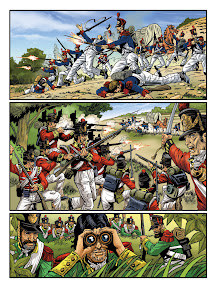
If you have followed this blog last year you will recall a couple of post's I made about Spanish Napoleonic comic's, Spanish Napoleonic Comic's and la Guerra de la Independencia en los tebeos, sadly there is no equivalent in the UK (or anywhere else on the planet outside Spain as far as I can see), well I was very surprised to hear that there is to be a Napoleonic comic strip to be launched in the UK in 2011!!

The strip is to be published in a magazine, called appropriately "Strip Magazine" by Print Media Productions, but they will also be publishing it as a graphic album which I think will be of more interest to us gamers. Could make for some great skirmish scenario's, maybe next a xmas stocking filler (remember I am the first to mention xmas) !

The strip is called Lawless and tells the incredible story of Jack Lawless and the Irish Legion, a band of renegades and outcasts who fought against against the British in the tumultuous era of the Napoleonic wars.

Written by Ferg Handley (Commando, GI Joe, Spider-Man) and drawn by Kev Hopgood (co-creator of Marvel's War Machine, artist on Games Workshop's Darkblade), Lawless is a creator-owned tale bringing historical action adventure back to British mainstream comics with a vengeance.

Lawless creator Kev Hopgood says of the tale: "I’ve been a huge enthusiast for the Napoleonic period since I can remember, but have never had the chance to tell a story with that setting before. Now is the time!"

"When Kev approached me with the concept, I bit his hand off," added Ferg. "I’ve always been fascinated by the Napoleonic era, and the Irish Legion angle made me think 'hmm, The Pogues in uniform…'"

Ferg Handley's first professional comic was Commando 3102 published in December 1997. Since then, he has written over 250 Commando titles and carved a name for himself largely as a popular comics writer for UK comics such as Spectacular Spider-Man, Marvel Heroes and GI Joe.

Kev Hopgood has a long a varied career in comic books and children’s illustration. Starting out with such strips as Zoids, Action Force and Night Zero for UK publishers he went on to went onto a three year run on Iron Man for Marvel Comics. During this time he co-created the character War Machine. Following a stint in the computer games industry he went to work on the Darkblade strip for Games Workshop.

Nowadays he splits his time between comic strip work for publishers Panini UK and Eaglemoss and children’s illustration for companies such as Oxford University Press, Barrington Stoke and Franklin Watts.

Sunday, November 28, 2010

Gearing Up for the Big Move

I am moving house next Saturday, so my 'Wargames Room' is getting all packed up at present, we have been in our present house for 15 years or so, lots of rubbish to get rid of before next weekend.

We're only moving 500 yds down the road but as I have learnt 500 yds or 500 miles doesn't make a lot of difference, it's still a PITA.

Trully sad thing is it will be goodbye to my wargames room for at least a few years.

I originally lost my wargames room when my kids came along 25 years ago, but as they went off to University I got it back and the last few years have been great, however a combination of kids moving back home after University and our new house having had the 'spare room' knocked into the Master Bedroom (which sold my wife on it) means I am out of luck, at least until my daughter decides to get married and move to Australia.

I have been promised a small area with a desk in our bedroom though I remain to be convinced how my wife is going to react to sleeping with the smell of drying enamel paint in the air!

As I begin to pack it all up my wife has said it will be 'interesting' as she put's it to find out exactly how many 'soldiers' I actually have (it's generally a closely kept secret LOL).

Sunday, November 21, 2010

More Book madness - reality bites

Well the order finally arrived, well actually packages 2/3 and 3/3 arrived last Saturday and 1/3 arrived this Saturday.

Firstly no complaints about service, Caliver is as ever first class, delivery is prompt, they are my favorite company to deal with on line!

However of 19 books, 6 had already been sold so were removed from my order, with Amazon you can be sure if it listed it's available, worst thing was that some of the best books were the ones that got dropped. Of the remaining 13 books I would say that Caliver's 'rating' system is consistently a grade lower than Amazon's, not that I am really complaining, the books were fine, just I got what I paid for, cheap books at a cheap price, whereas with Amazon you feel you get more than you paid for, quality books at a cheap price!

Maybe Amazon's postage is excessive (certainly it is compared to Caliver's) but you get the impression some of the excess covers better quality books.

Overall I wouldn't really criticise Caliver, they did what they said the would do after all, but I think in future, out of preference, I will stick to Amazon even if it does cost me more.

Sunday, October 24, 2010

Napoleonic Books

Over the last 3 or 4 months I have probably bought more books than in the last 20 years. The driving force behind this sudden splurge was a "discovery", though in reality a discovery of the obvious.

I have looked at and bought books off Amazon for many years, both for hobby interest and for my work but for some reason I had never clicked the links which show the "used" books, I guess because I imagined they would be chewed up, knocked about, with pages missing or covered in personal "notes".

However when researching for a post on this blog someone suggested I read a section of a book, I couldn't find the book in my local library and I was not going to spend the $50 that Amazon wanted just for a blog post, but then I saw I could pick up a used copy for $5, it's condition was stated as "very good" and it was a hardcover edition, well that was doable.

So I placed the order.

When it arrived I was surprised, well more amazed, I was expecting a well worn book, not that I was concerned by that, after all I just wanted to read the passage, I didn't care about the condition I just wanted "cheap", however the condition was excellent, to quote my father, "it looked like it had been read once and put back on the shelf"! That got me thinking, and I started looking at other books that I had heard of or looked at before but never been able to afford to buy.

Since then I have been regularly picking up cheap, used, good condition books from Amazon, the sort of books I would never consider or could never afford if new. All have been in fantastic condition, occasionally there has been the odd ex-library book but even these are in great condition just with the usual stamp in the front cover.

For example this week I bought "Historical Maps of the Napoleonic Wars" by Simon Forty for $2.46 that's around GBP1.50, pretty amazing I think. Then a couple of months back there was "The Fall of Napoleon, The Allied Invasion of France, 1813-1814: Volume 1" by Michael V. Leggiere which was $4.00 or GBP2.50. Or how about "The Exploits of Baron de Marbot" for $4.00 or GBP2.50 which was another one I picked up this week.


All these were hardcover, personal preference, I like hardcover books and they look good on the bookshelf. If you look at the Amazon bookshelf on the right (towards the bottom of the page) you can see some of the book's I have been buying. In a short period of time I think I have built up quite a "library" for next to nothing.

I created an Amazon store here , no I am not looking for you to buy from it, but I found it was a simple way to create a bunch of categorised list of books that I could easily go back to, I am maintaining the lists so as I get time I will subcategorise books for convenience.

Oh and if you need ideas for xmas gifts, well in the summer, after making this discovery, I bought half a dozen books for my father's birthday on Steam Trains, his passion, he was well stoked, and which was where his quote came from, if I had just bought new he would have had maybe one book,as it was I was able to give him an interesting selection including one on Scottish Railways where he was holidaying at the time.

Also I created a "wishlist" of the books I want to buy and have let my wife and kids know if they want to give me something for xmas a cheap used book will be more than appreciated, much better than have them buy me another belt and even my kids can afford a $5 book LOL!

Tuesday, October 05, 2010

la Guerra de la Independencia en los tebeos

A while back I posted about Spanish Napoleonic Comics, well here is a second dose!

If you can read Spanish there is an excellent (and long) article about this exact subject here, there is a wonderful shot of a squadron of Curassiers mounted the wrong way round! You can see it below if you don't want to download the article, the officer is calling his men a bunch of cowards and threatening them with being sent to Russia for the winter! The article originates from the magazine Researching&Dragona, nĀŗ6

The first set of pictures here are from a post on the GUERRA DE LA INDEPENDENCIA 1808-1814 blog, the second set of 4 are from the 'Asterix' era and came from this blog which is dedicated to Spanish 'classic' comics in general. The bottom picture is from a pamphlet for a 2008 exhibition the original can be found here. The artwork on the Talavera piece was by Dionisio Ɓlvarez Cueto who some of you will be familiar with, if not you can look here.

All these are sadly just a single pictures rather than the actual comics, but here is a link to one comic  that you can download or read online, this one is about Dos de Mayo and Goya, more an educational piece than a 'Sharpe' style adventure.


In the Asterix style


Or next winter you will be in Russia!

Historietas sobre la Guerra de Independencia

Friday, September 24, 2010

New: Napoleonic Wargame Flags from Battle Flag

Well just like buses when you see one there is another one sure to be right behind, I saw another news item on TGN about Napoleonic flags this one from BattleFlag about a new range of from them.

From their blog:
New: The British at Waterloo; Napoleonic Wargame Flags from Battle Flag
In response to all the emails requesting that Battle Flag produce a range of model wargame flags for the Napoleonic period I am pleased to say that first sets are ready.

Published on Brigade sheets, similar to Battle Flag’s popular ACW range of wargame flags, Napoleonic wargamers can now purchase flags of complete British Brigades (with their allies and adversaries to follow).

The plate sheets are available in both 15mm and 25/28mm sets.

With the variation in the size of model soldiers between manufactures I have never held that one size of wargame flag fits all ranges. Therefore I have created this range to allow wargamers and collectors of military miniatures to specify what size they want these flags to be. The 25mm flags can be anywhere from 30mm to 40mm in size and the 15mm from 18mm to 22mm.

There will be quite a number of new releases over the coming weeks for all the periods that Battle Flag now produce and just one or two surprises as well.

You can order these or any of our other sets of model wargame flags at Battle-Flag.com

Currently there are two sheets in the range:
BaW1 The 10th Brigade:
The King's and Regimental Colours of ; 4th (Kings Own) Foot, 27th (Inniskilling) Foot 40th (Somerset) Foot, 81st Foot
Baw2: The 5th Brigade
The King's and Regimental Colours of ; 30th (Cambridgeshire) Foot, 33rd (1st West Riding) Foot, 69th (South Lincoln) Foot, 73rd (Highland) Foot

Both are GBP7.50 each plus pp and you get to choose the size (!)
Please specify the size of flag required when ordering. Flags available from 30mm to 40mm on the hoist. If not specified the standard size, 36mm, will be supplied.

How do you surprise people about flags? Maybe they mean Landwehr to coincide with WG's release. If it is they just need to be careful, I think the WG box comes with flags and if your are going to be a 'replacement' then there has to be some unique selling point to pull people in.

Anyway they do look excellent quality and the price is very fair so no complaints there, they would certainly be on my 'list' if I was looking for flags.

The idea of grouping the flags by brigade is novel, though I am not sure at 28mm people build there units strictly by brigade, you tend to have fewer units and pick your own personal 'favorite' regardless of how they were actually brigaded. So will people find that a 'put off' because half the pack turns out to be 'surplus to requirement', I am not sure but I will give them kudos for the idea and giving it a try.

However I don't want to take anything away from them but all of a sudden there are an awful lot of people making Napoleonic flags aren't there, I wonder do we really need so many or more importantly can we support so many?

Of course you can argue that with the British flags being so different between regiments no one (except GMB) covers them all so we need more sources, but maybe we need fewer companies but ones that cover a broader range instead?

Actually it would be nice if you are going to introduce a new range to do something different instead of just banging out the 'same old' however good the quality, like for example SCM the other day were doing linen flags, at least its was different!

Not trying to beat up on BattleFlag but if there is another 'new range' from someone I might feel the need to yawn and ask why bother?

Anyway personally I have now decided that linen really is the way to go, paper is just so yesterday....

... and to think not long ago all there was was GMB how quickly this hobby is changing...

Its all GMB's fault anyway, they made their flags so hard to buy and pricey this was always going to happen someday, however they still set the 'standard' (sorry) and have by far the most extensive range, everyone else is still playing in the shallow end but with plastics being so popular at the moment maybe that's where the money is.

Maybe we need a review of what is available today in the market for 28mm Napoleonic flags, hmm...

Thursday, September 23, 2010

Napoleonic British Artillery Colour

You may recall a few month's back I bought some of the new Perry Royal Horse Artillery limber's, this led me to start thinking about what colour I was going to paint them.

As a bit of an old timer I have traditionally used 'British Equipment Grey' from the Humbrol Authentic range an enamel paint I bought in the 70's ('old timer' paints really last for a lifetime!). In the '70's you never had to argue over what shade to paint your Napoleonic's, French were French Blue, British were British Scarlet, you name it there was a colour for it even the infamous 'Polish Crimson'. So without ever a thought of whether it was right or wrong, 'British Equipment Grey' just was 'the' colour, simpler days. Of course these days the Humbrol's tend to get put down, if they even come up in conversation, as just a marketing strategy and they just threw in any old paint.

These days however everything you see, from books, to models, to websites use a very light grey for British field equipment, some even use what looks to me to be a light blue(?!!). So I started to wonder whether in the light of modern research had light grey been proved to be the real colour to use?

So I started to look through the books to find if there was a definitive answer to what the colour was. As it happens there are surprisingly few contemporary colour prints of British artillery pieces, and most books use modern day artist drawings and have little to say on the actual colour. However I did find in that masterpiece of a work 'British Napoleonic Field Artillery' by C.E. Franklin a small section devoted to exactly this subject, so lets take a look at that and I will continue below;

From British Napoleonic Field Artillery by C.E. Franklin
Colour of Artillery Equipment
There is some dispute between different authorities regarding the colour of artillery equipment. The contemporary paintings show a dark grey colour, but modern artists seem to prefer a blue-grey. As far as can be determined during the Napoleonic period all wood and iron work of artillery equipment was painted to protect it and the brass gunes were polished when circumstances warranted but were usually left dull on campaign(45).

There are several indicators that the carriages were painted; Dickson recorded in December 1809 that his brigade had been sent to Quinta Nova for just that purpose(46). The facilities in the Royal Carriage department included 'painters stores and sheds for the painting of carriages' and there are several references to the cost of paint colours and and oil(47). One reference in 1812 specifically refers to gun carriages painted in a 'lead colour'(48). One of the few paintings to show such equipment is David Morier's 'Royal Artillery in the Low Countries'; this shows a darkish grey, which matches the description 'lead' (49).

According to later records of 1858 when white zinc oxide had replaced white lead, all wood was painted a grey, called 'lead', later 'white lead':
The principal ingredient, used in making paint in this Department, is the oxide of zinc. The raw oxide is mixed with raw linseed oil, in the proportion of two gallons of oil to one cwt. of oxide, it is then incorporated in a pug mill, and afterwards passed between stone rollers until it acquires a uniform consistency; in this state it is termed 'ground white zinc', and is stored in kegs until required for use. the proportions of the ingredients for making the several kinds of paint used in the service are as follows:

For Carriages, &c. for Home Service

Ground oxide, of white zinc 112lb
Lamp-black 6lb
Oil (bolied), for grinding 3 quarts
Manganese, as a drier 8 ounces
Raw linseed oil, for mixing 2.5 gallons
Bold linseed oil, to give body and gloss 2.5 gallons
Turpentine, for thinning and drying 2.5 gallons
The above ingredients are carefully incorporated and strained through a wire sieve to make 197lb. For tropical climates, where a lighter colour is required, the lampblack is reduced to 1lb mixed with one pint of boiled oil.

Black Paint, for Iron Work

Lamp-black56lb
Boiled oil, for grounding 8 gallons
Boiled oil, for mixing 4.5 gallons
Turpentine 1 quart
Rd lead for drying 2lb
Litharge for drying 4lb
The above ingredients are carefully incorporated and strained through a wire sieve to make 164lb(50).

There is no evidence to support the use of any other colourant and while ironwork was painted black the metal ends of the shafts, the elevating mechanisms, trunnion bearing, inside of the capsquares, axletree arms, linchpins and the washers were not painted but 'kept bright' and lightly oiled. Tests conducted with the relevant pigments and oils give two quite different tones of grey.

The re-enactor or modeller should note when lead white is mixed to the above recipe it produced a colour very similar to Dulux, Ebony Mist 3. The zinc white, used after the period, produced a darker grey similar to Dulux Ebony Mist 2. Analysis of the sample of the earlier paint using white lead was sent to the NCS Colour Center and provide NCS reading of 'S 6000-N'. NCS Colours can be obtained at a variety of outlets including Dulux, crown, Johnston and Leyland. A similar analysis was carried out by DG Colour using the 'Munsell' system and this gave a grey scale reading that is nearest to N.45. A further sample was sent to Humbrol Modelers Paints. The modeller will find their nearest equivalent is Matt Ocean Grey 106, which is equivalent to Revel 47.

In 1861, the colour of British artillery equipment was changed to green, to make the equipment less conspicuous, but this was abandoned in December 1862, and the colour reverted to the original lead colour.

Notes:
45 Mercer, 1807 p333
46 Dickson, 1908 pp.126,130,142,145
47 Hogg, 1963 pp485,527
48 Henry, 2003 p16
49 Morier, D. Royal Arillery in the Low Coutries Rotal Collection cat#125
50 HMSP, 1858 p11


So there is plenty of specifics there, and I was stunned to see Humbrol mentioned, they had actually been part of the test to find out what the colour was, even the colour was given, Matt Ocean Grey 106, which surprised me even more as I have known for years that that colour actually was the old Authentic's 'British Equipment Grey'. So it seems these guys did do some proper research and maybe those Authentic's aren't quite as shabby as some would now like us to believe.

However I was left with a couple of questions, why if that was the colour do all the illustration's in Franklin's book use a very very light grey and was the Humbrol colour really a match for 'S 6000-N' as stated?

Well recently I had a conversation with Dr. Stephen Summerfield at the Napoleon-Series forums about Franklin's note. He told me that when Franklin was putting together his book he had advised Franklin about how white lead and not zinc oxide was in use during this period and that the illustration's were too light a colour and the correct colour should be 'Mid Grey', this was rather late in the production of the book hence the illustrations were not changed to reflect the new information.

One other piece of useful information from Stephen was that 'white lead' actually reacts to the hostile acid environment of oxides of sulphur and nitrogen plus hydrogen sulphides i.e. gunpowder, causing it to darken with use.

So that's one mystery resolved, but now what does 'NCS S 6000-N' look like, well there is a problem here, both the NCS and Maunsell color systems are proprietary color models generally used by commercial and professional organisations, for that read 'have to pay very large sums of money for'. However they do have an online resource that supposedly converts between the NCS color model and the more common RGB color model here. Also exactly what does the 'Mid-Grey' that Dr. Stephen Summerfield speaks of look like.

Below are the two possible RGB colours:

'Dark Amberish Gray'

'Mid Grey'

The second colour is Dr. Stephen Summerfield's 'Mid-Grey' and actually is a match for the Humbrol colour I have (FYI the Humbrol paint swatches on their website bear absolutely no relation to how the colours looks in real life, and that's for all colours not just this grey), the first colour is the NCS colour as converted by the NCS color navigator. They are different and the NCS colour is not really a good match for the Humbrol colour I have, though I feel it probably represent's the colour 'newly applied' whereas the Humbrol is a 'used in the field' mid-grey.

I should also note that trying to work out the correct shade of colour using a computer monitor is a difficult thing to do, there is a wide variance in how a colour looks between different brands and different types of monitor, having worked in IT in the fashion industry for a while it used to cost a lot of money to have monitors capable of displaying accurate colour shades that could be translated into 'real world' colours. In fact those two colours above look quite different at the top of my screen to the bottom of the screen due mainly to variation's in brightness as well as viewing angle and other factors. Also if you are looking at pictures of models on the web then you have to allow for the lighting used when taking the shot having a substantial impact on the perception of the colour.

So there you have it, from my perspective at least, until someone can come up with solid fact's to prove otherwise I am reasonably happy to say that the Humbrol colour was based on real research, unlike any other colour you can mention, and it probably represents the colour of equipment as it was in the field in the Napoleonic era that had gone though a battle or two and that's what I have gone with.

Thursday, September 16, 2010

Spanish Napoleonic Comic's


I came across a Spanish site with a bunch Napoleonic comic's, some of them dating back to the 1940's but they run through into the mid-80's.

I never knew such a thing ever existed, I don't know whether this was a peculiarly Spanish thing but I can't recall anything similar in the UK, well at least not for Napoleonic's there was of course an equivalent for WWII in the 'Battle' comic's, maybe therein lies at least part of the answer. For sure Conan Doyle's Brigadier Gerard stories are Napoleonic themed but the comic 'medium' is a very different thing and much more accessible so we are talking of something very different.

It seems that Spanish comic's have existed since the 1860's though they really took of after the Civil War, with the golden era being the '40's. The suggestion is that these theme's were compatible with the political atmosphere of the times. Though the number of comic's covering the War of Independence was small they emphasised the guerrilla war rather than the action's of the regular army, portraying the individual hero beating off the evil or unintelligent foreign invader. Interest waned in the '50's with the comic's disappearing altogether in '52 only to reappear some time later with more historical accurate drawing and storyline but a maybe less accessible message in to a changing political climate, by the 70's the comic's had elements that could be seen as mimicking an 'Asterix the Spaniard' image though by the '80's the comic's are telling a historically focused story set in a largely historical accurate context. Today the comic's have largely disappeared in Spain, at least those covering the War of Independence are no longer in existence.


My Spanish is almost none existent but these comic's do make interesting reading anyhow and there just has to be a Sharpe Practice Scenario or two in every issue don't you think? Worth taking a look at I think if only for curiosity value, note the comics can be a little slow to download from the site, be patient.

Saturday, September 11, 2010

Helion 28mm Range - Seven Weeks’ War of 1866

Taking a little break from Napoleonic's for today.

I guess like more than a few I have looked with interest at those stunning books released by Grand Tactical Rules 1870, 1859 and 1866. Although aimed at 6, 10 or 15mm, 80% of each book is about the historical background and look simply awesome. I got the 'itch' after seeing those amazing books, and I just had to replay some of those engagements but I only do 28mm and I wasn't aware of a suitable range (excluding Foundry, who are just way too expensive especially if buying from o'seas) so the idea and my enthusiasm cooled.

Well I came across a post today on another site that mentioned a company that I had never heard of before called Helion & Company Ltd. making 28mm figures for the APW so I went and had a look and I was very impressed.

Apparently this company had produced a similar range in the late 90's but then stopped, however the current range is an all-new range, using a new designer, new mouldmaker, and new production facilities, and not a re-release of the old figures.

They seem to be quite active as well, with news posted only last week and a list of future plans.

The figures are priced at GBP8.5 for a pack of 8, but shipping is free world wide, they also offer unit packs of 32 figures including command for GBP30.00 and there is a 'loyalty' scheme which effectively gives you another 5% discount. You can't complain about that at all can you!

Some pics of their range below,but check out their site for yourself.


If this was earlier in the year I would dive in and get some today but at the moment with the WG/Perry Prussians and Ehmke's Wurttenbergers on the immediate horizon I am going to be a bit tied up for the next few months but these would be nice for xmas to make a Sharpe's practice sized large skirmish game with say a 100 or so per side.

Thursday, August 19, 2010

Counter Battery Tactics at Waterloo

Another in a series of articles taking a look at the reality of the Napoleonic battlefield particularly so that we can consider whether our wargame rules are really reflecting this reality. This time we look at they way artillery were countered on the battlefield both direct artillery counter battery fire and infantry skirmisher fire.


Here is an interesting extract from the report made by Captain d'Huvele on the Hanoverian Battery of Major Braun at Waterloo, this is taken from "Waterloo Hanoverian Correspondence Volume 1" by John Franklin well worth reading:

Towards 2 o'clock we were ordered to deploy... 

Hardly had we arrived on the height when the howitzer's ammunition cases were set alight by one of them enemy shells, and exploded into the air. The howitzer was destroyed, while 1 serjeant, 1 gunner, and 4 horses were killed and 1 serjeant, 2 gunners, 1 driver and 2 horses were wounded

Towards 3:30pm an English 9-pound battery reinforced the left wing of our Hanoverian Battery. But two cannon from this battery were destroyed within a very short period of time and several ammunition wagons, which stood immediately to the rear, exploded; two other ammunition wagons were damaged in such a way that they could no longer be used. The English Battery moved from this position shortly thereafter and a considerable amount of ammunition was left behind.


So within the space of an hour and a half 3 guns are knocked out, no doubt this is a hot part of the battlefield but thats pretty effective French counter battery fire.

He continues:
We were the subject of incessant fire from the enemy's Tirailleurs, who pushed forward to within a short distance from the battery and maintained themselves without being repelled by our infantry, and we were also cannonaded heavily by the enemy's artillery which was positioned on the heights opposite. The fire from the enemy Tirraileurs was most harmful to the battery, because it was not protected. The loss the battery sustained in wounded increased, and it should be noted that this was mainly due to the fire from the enemy Tirailleurs. The rocket battery remained for about an hour on its position and it also suffered considerable losses during this time.

Towards 6 o'clock in the evening the battery had been reduced to such an extent, due to the number killed, wounded and those who had carried their wounded comrades to the rear etc., that only 3 cannons were manned and could be operated. However this small group of brave men diminished every moment, so that towards 6:30pm I had to ask some of the Scotsmen to help serve the cannon.


Note the effectiveness here of skirmish fire, they have effectively lost another 4 guns in the space of 2 to 3 hours due to it. Maybe this was during the phase of cavalry attacks and their own skirmish line was withdrawn leaving the artillery more exposed than it would otherwise have been.

At this time three cannon belonging to the enemy horse artillery moved up which fired at the battery with canister. But after a few shots from our Hanoverian Battery one of these cannon was destroyed and the others withdrew. After several of the Scots had been injured or killed, only one cannon remained active (it was manned by 2 serjeants, 2 corporals, and 5 gunners). They fired the last of the ammunition, despite the fact that a serjeant had been sent to obtain more at about 3 o'clock in the afternoon, but he had not returned.


Again counter battery fire was pretty effective here in quickly knocking out one of the French guns but equally skirmish fire then wore down the battery and they have been effectively put out of action. How often in your won games do you see a battery put out of action from skirmish fire alone.


It was towards 7:30pm when the last cannon finally exhausted the last of the ammunition and was ordered by Major-General Sir James Kempt to withdraw. The brave Scots helped limber the guns, as the artillerymen had insufficient strength left to do this. The cannon on the right wing had to be left, because there were not enough horses and because one of the wheels was broken.

So the battery is withdrawn but half of it remains stuck on the field because of no limbers, if the withdrawal had been part of a general retreat then these piece would have been effectively lost.

Now lets look at another account, Marbot in his memoirs talks of a counter battery tactic that he first came up with at Leipzig in 1813, but used "with great effect two years later at Waterloo" here he recounts its use in 1813:

Then I tried a new plan, namely, to send troopers, well apart, to fire at the enemy's gunners with their carbines. This made the enemy also send out skirmishers, and when skirmishing was thus going on between the lines the enemy's guns could not fire on us for fear of hitting their own people. Ours were of course similarly hampered; but to get the artillery silenced on even a small part of the line was all in our favour, as the enemy was far superior in that arm. Moreover, our infantry was just then at close quarters with that of the enemy in the villages, and the cavalry on both sides had nothing to do but await the issue; so it was of no use for either side to be smashing up the other with cannon-balls. A skirmishing engagement, in which for the most part more powder is burnt than damage done, was a much better way of spending the time. Accordingly, all the colonels followed my example, and much bloodshed was saved. All the cavalry colonels of the 2nd corps approved so highly this plan of economising human life that we all agreed to employ it on the 17th.

Although Marbot is not always the most reliable of witness's this was a tactic used at Leipzig, none the less its an interesting use of skirmishers, it again underlines there importance on the Napoleonic battlefield and it does show how artillery, powerful though it was, could be countered.


So enemy skirmirmish fire seems to be very effective indeed but it can be neutralised by your own skirmish line. You need to get your skirmish line out and push them up and then they can do significant damage unless of course your opponent neutralises your line with his own, maybe you can drive him off with your cavalry but do you want to fritter away your cavalry against skirmishers. You start to get the feeling that there is a whole series of interconnected options here and a price to pay for each giving a much more varied structure to the deployment.

Also artillery counter battery fire seems very effective when used, though artillery is more often given other targets in support of infantry or cavalry attacks.

The Duke Of Wellington allocated these positions to the batteries personally, along with the strict orders not to engage the enemy artillery  except in the case of emergency, but only to let the troops  moving against  our position feel  our potency, and to be economical with our ammunition.
Captain Cleeves 4th KGL Foot Artillery Battery.

The Duke Of Wellington, who visited us on a number of occasions, personally ordered me not to exchange fire with the enemy artillery.
....
At this time a strong enemy artillery battery of the highest calibre fired at us from a position 1,200 paces away, but because of the order I received from the Duke of Wellington, I did not return fire.
Major Kuhlmann  2nd KGL Horse Artillery Battery

Many rules make counter battery fire at the level of  "don't waste your time" it seems more the case they generally had more important things to do with the ammunition available.

Sunday, August 15, 2010

Colonel Saint-Chamans - Liepzig 1813


Comte De Saint-Chamans was the Colonel of the 7e RĆ©giment de Chasseurs Ć  Cheval when he was wounded on the 17th of October 1813 in the vicinity of Wachau during the Battle of Leipzig. The 7e Regiment was ultimately to be destroyed in this battle losing some 17 officers and barely 100 men remained of the 3 squadrons by the the time the French retreated on the 19th.

The morning of the 17th began well enough, at 8:00am his good friend Generale Boyer, who's brigade was posted in a nearby village, came to tell him he had some patƩ and a few bottles of white wine which he proposed to share with him.

Saint-Chamans, who had been sulking for several days over a decoration that he thought he richly deserved but didn't receive, was over the moon as it had been months since he had had such fine food, unfortunately hardly had they sat down to eat than a cannonade commenced and "as all to often happens in the French Army" they had to rush off "to fight on an empty stomach".

The Regiment found itself in front of some Austrian cavalry but were not strong enough in this sector of the field to launch an attack and so engaged only in some light skirmishing. Marbot's mentions this as a deliberate plan of all the regiments of 2e Cavalry Corps and in typical Marbot style claims responsibility for it.

Then I tried a new plan, namely, to send troopers, well apart, to fire at the enemy's gunners with their carbines. This made the enemy also send out skirmishers, and when skirmishing was thus going on between the lines the enemy's guns could not fire on us for fear of hitting their own people. Ours were of course similarly hampered; but to get the artillery silenced on even a small part of the line was all in our favour, as the enemy was far superior in that arm. Moreover, our infantry was just then at close quarters with that of the enemy in the villages, and the cavalry on both sides had nothing to do but await the issue; so it was of no use for either side to be smashing up the other with cannon-balls. A skirmishing engagement, in which for the most part more powder is burnt than damage done, was a much better way of spending the time. Accordingly, all the colonels followed my example, and much bloodshed was saved. All the cavalry colonels of the 2nd corps approved so highly this plan of economising human life that we all agreed to employ it on the 17th.

The divisional commander Exelmans however did not approve of this idea but as Marbout continues;

... as he was always rushing from one wing to another, as soon as he was a little way from a regiment the colonel would send out his skirmishers and the artillery would cease to speak.


However in front of Saint-Chamans the Austrian's ordered up a battalion of infantry and a horse battery to try to dislodge the chasseurs.

Around 10:00am as they came under direct fire from the battery they began to take heavy casualties, men were being wounded and others were leaving to help them to the rear and as they could do little to respond the Chassuers started to become a little unsettled, Saint-Chamans was just about to say some encouraging words when he himself was thrown from his horse, landing unconscious on the ground.

He appears to have been in some respects extremely lucky, in that the roundshot that knocked him from his horse seems not to have directly struck but instead had hit his giberne, however the blow was strong enough to throw him from his horse, leaving him with concussion, broken ribs and coughing up blood, he remarks he was to have chest pains for many years as a result of this incident.

Saint-Chamans was carried back to the village where he had breakfasted with Boyer, he was attended by his surgeon and another Doctor from the 23e Chasseurs (Marbot's Regiment), they decided he needed bleeding which they proceeded to do immediately.

The village came under attack and looked like it would fall, it was proposed to move Saint-Chamans back to Liepzig, two leagues away, on a stretcher. They made there way slowly along the road but a mile from Liepzig at a larger village they had to stop as they were told the road had been cut by Cossacks, so they found a nearby house to rest in. About 8:00pm they heard the roads had been cleared and they continued in to Leipzig.

On the 19th came the news that the French were to retreat, the house where Saint-Shamans lay was then occupied by some of Marshal Augereau's Grenadiers who prepared to defend it forcing the group to move on. Saint-Chamans was eventually carried to the Hotel de BaviĆØre, occupying the same room that Marshal Ney had previously been using, Saint-Chamans was accompanied by a Doctor, his Surgeon and his brother who also served in the 7e Regiment. Saint-Chamans was too ill to be moved further and the hotel passed into allied hands as the French retreated.

The hotel was first occupied by some passing Prussians who relieved the Saint-Chamans' party of all their money and watches, then later in the day it was occupied by several Russian staff officers who refused to believe the group had been robbed as strict orders had been given that anyone found looting would be shot. They were told to stay in their room and be quiet which they nervously did. Around 10:00pm there was a pounding on the door and they opened it to find a very drunk Cossack Officer and the following conversation then took place:

Cossack - Give me money, I want money.
Doctor - We have nothing, the Prussians took everything from us this morning.
Cossack - The Prussians! Oh, the thieves! Give me your watches, I want your watches.
Doctor - The Prussians have taken them also this morning, they have left us with nothing.
Cossack - The Prussians! ... Those robbers ... You have nothing for us?
Doctor - Alas! No, and here in this bed sir is my Colonel badly wounded, and who has been deprived of everything.
Cossack - Those beggars, what thieves, the Prussians! ... But yet you still have something for me?
Doctor - Look, look for yourself around the room, we have only our clothes.
Cossack - Thieving Prussians! ... but what is this ? (Looking at the strap of Saint-Shamans sword)
Doctor - This is the Colonel's sword.
Cossack - The Colonel is a prisoner ... he no longer needs a sword ... (Looking again at the strap) It's a very nice sword ... I need one... I think I will take this sword for myself ... You don't have anything else?
Doctor - Nothing.
Cossack (opening the door to leave) - Oh, those stealing Prussians! Thieves, I will find them, they must pay me my share!

The night passed without further disturbance, but to prevent a repeat occurrence of the days events they decided they needed to seek protection, they knew enough of the Prussians to want to avoid becoming their prisoner and the idea of being taken by the Russians horrified them, so for several days Saint-Chamans tried to have himself made a prisoner of the Austrians, first through the Austrian staff officers now billeted in the hotel and then later through someone on Bernadotte's staff who knew Metternich but all to no avail.

Ultimately he became a prisoner of the Swede's under Bernadotte and it was some 21 days later that he, along with 40 other officers, left Leipzig heading north to Straslund and then on to Rostock. Eventually he was to be paroled and returned to France, after many trials and tribulations, in 1814. It has to be said that despite the parole this only happened through the repeated intervention of Bernadotte, though Saint-Chamans believed that some of Bernadotte's motivation lay with his aspirations for the French throne after the inevitable removal of Napoleon.

He arrived in Paris on the 23rd March a few days ahead of the Allies but bound by the terms of his parole he felt he could not take part in the final actions of the Empire though one has to imagine that his health at that point would probably have prevented him from being of any useful service anyway. In 1815 he didn't support Napoleon and was made non-active during the hundred days.

Saturday, August 07, 2010

Crag Piquet (Part II) 15th December 1863

The North-West Frontier didn't seem to be too popular with you all, though for me, my interest is somewhat piqued, maybe a small skirmish game say very much in the old vintage style wargaming would be ideal. Rules? Figures?

Anyway I might as well finish off Crag Piquet, here is the action from the 15th/16th December that finally wrapped it all up after three months of being stuck at Crag Piquet. This from an account by FS Roberts. (see part I to catch up on where we are at).

Sir Hugh Rose had been accorded permission to take command of the troops in the field, and had sent word to General Garvock not 'to attempt any operations until further orders.' James (the Commissioner), however, thinking that the situation demanded immediate action, as disturbances had broken out in other parts of the Peshawar valley, deprecated delay, and pressed Garvock to advance, telling him that a successful fight would put matters straight. Garvock consented to follow the Commissioner's advice, and arranged to move on the following day.

The force was divided into three columns. The first and second--consisting of about 4,800 men, and commanded respectively by Colonel W. Turner, C.B., and Lieutenant-Colonel Wilde, C.B.--were to form the attacking party, while the third, about 3,000 strong, under the command of Lieutenant-Colonel Vaughan, was to be left for the protection of the camp.

At daybreak, on the 15th, the troops for the advance, unencumbered by tents or baggage, and each man carrying two days' rations, assembled at the base of the 'Crag piquet'. Turner, an excellent officer, who during the short time he had been at Umbeyla had inspired great confidence by his soldierly qualities, had on the previous afternoon reconnoitred to the right of the camp, and had discovered that about 4,000 men were holding the village of Lalu, from which it was necessary to dislodge them before Umbeyla could be attacked. On being told to advance, therefore, Turner moved off in the direction of Lalu, and, driving the enemy's piquets before him, occupied the heights overlooking the valley, out of which rose, immediately in front about 200 yards off, a conical hill which hid Lalu from view. This hill, which was crowded with Hindustani fanatics and their Pathan allies, was a most formidable position; the sides were precipitous, and the summit was strengthened by 'sangars'. No further move could be made until the enemy were dislodged, so Turner lined the heights all round with his Infantry, and opened fire with his Mountain guns.

Meanwhile, Wilde's column had cleared off the enemy from the front of the camp, and formed up on Turner's left. On the advance being sounded, Turner's Infantry rushed down the slopes, and in ten minutes could be seen driving the enemy from the heights on his right; at the same time the 101st Fusiliers, the leading regiment of Wilde's column, made straight for the top of the conical hill, and, under cover of the fire from the Mountain guns of both columns, and supported by the Guides, 4th Gurkhas, and 23rd Pioneers, they climbed the almost perpendicular sides. When near the top a short halt was made to give the men time to get their breath; the signal being then given, amidst a shower of bullets and huge stones, the position was stormed, and carried at the point of the bayonet. It was a grand sight as Adye and I watched it from Hughes's battery; but we were considerably relieved when we perceived the enemy flying down the sides of the hill, and heard the cheers of the gallant Fusiliers as they stood victorious on the highest peak.


Now that the enemy were on the run it was the time to press them, and this Turner did so effectually that the leading men of his column entered Lalu simultaneously with the last of the fugitives. The rapidity of this movement was so unexpected that it threw the enemy inside the walls into confusion; they made no stand, and were soon in full retreat towards Umbeyla and the passes leading into Buner.

While affairs were thus prospering on our right, the enemy, apparently imagining we were too busy to think of our left, came in large numbers from the village of Umbeyla, threatening the camp and the communications of the second column. Wilde, however, was prepared for them, and held his ground until reinforced by Turner, when he made a forward movement. The Guides, and detachments of the 5th Gurkhas and 3rd Sikhs, charged down one spur, and the 101st down another; the enemy were driven off with great slaughter, leaving a standard in the hands of the Gurkhas, and exposing themselves in their flight to Turner's guns. During the day they returned, and, gathering on the heights, made several unsuccessful attacks upon our camp. At last, about 2 p.m., Brownlow, who was in command of the right defences, assumed the offensive, and, aided by Keyes, moved out of the breastworks and, by a succession of well-executed charges, completely cleared the whole front of the position, and drove the tribesmen with great loss into the plain below.

All opposition having now ceased, and the foe being in full retreat, the force bivouacked for the night. We had 16 killed and 67 wounded; while our opponents admitted to 400 killed and wounded.

The next morning we were joined by Probyn with 200 sabres of the 11th Bengal Lancers and the same number of the Guides; and after a hasty breakfast the order was given to march into the Chamla valley. My duty was to accompany the Mountain batteries and show them the way. As we
debouched into comparatively open country, the enemy appeared on a ridge which completely covered our approach to Umbeyla, and we could descry many standards flying on the most prominent points. The road was so extremely difficult that it was half-past two o'clock before the whole force was clear of the hills.

General Garvock, having made a careful reconnaissance of the enemy's position, which was of great strength and peculiarly capable of defence, had decided to turn their right, a movement which was to be entrusted to the second column, and I was told to inform Turner that he must try and cut them off from the Buner Pass as they retreated. I found Turner close to Umbeyla and delivered my message. He moved forward at once with the 23rd Pioneers and a wing of the 32nd Pioneers in line, supported by the second wing, having in reserve a wing of the 7th Royal Fusiliers.

When we had passed the village of Umbeyla, which was in flames, having been set fire to by our Cavalry, the wing of the 32nd was brought up in prolongation of our line to the right. The advance was continued to within about 800 yards of the Buner Pass, when Turner, observing a large body of the enemy threatening his left flank, immediately sent two companies of the Royal Fusiliers in that direction. Just at that moment a band of 'Ghazis' furiously attacked the left flank, which was at a disadvantage, having got into broken ground covered with low jungle. In a few seconds five of the Pioneer British officers were on the ground, one killed and four wounded; numbers of the men were knocked over, and the rest, staggered by the suddenness of the onslaught, fell back on their reserve, where they found the needed support, for the Fusiliers stood as firm as a rock.

At the critical moment when the 'Ghazis' made their charge, Wright, the Assistant-Adjutant-General, and I, being close by, rushed in amongst the Pioneers and called on them to follow us; as we were personally known to the men of both regiments, they quickly pulled themselves together and responded to our efforts to rally them. It was lucky they did so, for had there been any delay or hesitation, the enemy, who thronged the slopes above us, would certainly have come down in great numbers, and we should have had a most difficult task. As it was, we were entirely successful in repulsing the 'Ghazis', not a man of whom escaped. We counted 200 of the enemy killed; our losses were comparatively slight--8 killed and 80 wounded.

We bivouacked for the night near the village of Umbeyla, and the next morning the Bunerwals, who, true to their word, had taken no part in the fighting on the 15th or 16th, came in and made their submission.

.... So back to Napoleonic's next week ....