Saturday, June 26, 2010
Battle Of Shevardino, 5th September 1812
On September 4th the French army again moved forward. Behind a ravine, near Gridnevo village, a heated fight developed between the Russian rear-guard under the command of Lieutenant-General Konovnitsyn, and the French troops of the King of Naples, Murat, supported by the Viceroy of Italy, Eugene. Night stopped the battle, and Konovnitsyn's troops that had held the field of battle retreated to the Kolotsky Monastery in darkness. It was a very difficult time for these rear-guard forces because they had been a engaged with a very large enemy cavalry force, and Napoleon's main forces had kept them in constant sight, forcing Konovnitsyn to continue fighting while retreating.
Kutuzov needed to either retreat more quickly or he needed to do what he had originally planned, to stop near the Kolotsky Monastery, fortify this position by absorbing the rear-guard of Konovnitsyn into his main force and await Napoleon.
Early in the morning of September 5, after throwing bridges over the stream separating the two armies, Compans' 5th Division rolled forward, supported by 1st and 2nd Reserve Cavalry Corps. They pushed through Fomkino and Doronino in dense columns preceded by a cloud of skirmishers, pushing the Russian pickets in front them.
A French battery unlimbered near Valoueava, on a low ridge where it was supported by seven companies of skirmishers. Those guns fired in support of the advancing infantry, limbering up to move ahead with the column, unlimbering to fire on the Russians time and again until they were finally within cannister range of the Shevardino redoubt itself. After firing for nearly two hours they moved against the village of Doronino and the adjacent woods.
At the same time Poniatowski advanced against Yelnia, driving out the Russian garrison there. Some Russian dragoons charged, driving back the exposed French skirmishers, while a small force of hussars slammed into the French column marching against the Russian guns. The French were driven back.
While the Russian skirmishers were retreating on the Russian right, one of their dragoon regiments attacked and disordered two French columns then also and threw back a French cavalry probe. But the advance of Poniatowski's Poles up the Old Smolensk Road threatened their flank and forced them to withdraw in turn.
Gen. Maj. Lowenstern misread the situation, reporting to Bagration about the valiant and successful defense of the redoubt. When he returned to his command he found the artillery and some of the infantry streaming back toward the main Russian lines. He responded quickly and sent another battery and a brigade of 27th Division forward to support the position. The 27th advanced to pointblank range and engaged the French with musketry.
Two French regiments then moved to attack the left of the Russian 27th. Two other regiments on the right of the French 5th Division were to turn the Russian right. Simultaneously, Morand and Friant moved on the village of Shevardino, but were stopped by a violent Russian fusillade. Four French guns moved up under the cover of the infantry and began to fire cannister into the dense Russian ranks. Shaken by the artillery fire, those Russians crumbled under a bayonet assault. The French swept into the redoubt to find their fire had already killed everyone in it.
What had begun as a small engagement for maneuvering room had rapidly escalated into a general battle between the two armies' wings. Prince Gorchakov sent the 2nd Grenadier Division to relieve the battered 27th Division. The rest of 8th Corps was sent to retake the redoubt,. which they did after a bloody assault. The sole intention of Gorchakov was to hold it long enough to let night fall and end the battle.
The French columns began to close in on the 2nd Grenadier Division from the left. The Russians counterattacked with two cuirassier regiments (Little Russia and Gloukhov). One flank of the cuirassiers was covered with 2 squadrons of Kharkov Dragoons and the other flank with 2 squadrons from Chernigov Dragoons. The French 111th Line Infantry Regiment tried to form square against the charging cavalry. One battalion was destroyed while other battalions became disordered. Louis Gardier of 111th wrote: "... Russian cuirassiers, who claimed to be our allies and indeed looked like the Saxon cuirassiers, appeared. Assuming that they arrived to charge the enemy, we allowed them to pass nearby. But they rallied behind us and charged, killing anyone who came under their sabers." The cuirassiers killed 300 men and captured 3 guns. The disordered 111th Line Regiment was then shattered by a friendly fire from a French battalion standing near the village.
General Friant's infantry division already stood north of Shevardino. Its 2 Spanish battalions of the Régiment Joseph Napoléon marched toward the village when Russian dragoons charged them. The Spaniards formed squares and opened fire. The dragoons fell back. The remaining regiments of Friant's 2nd Infantry Division (15th Light, 33rd Line, 48th Line, and artillery - all French units) were much less molested by the cavalry. Russian cavalry also pressed elsewhere on the field, forcing the French to take defensive measures.
Darkness finally fell, but it did not end the battle. The French began to turn the redoubt's southern flank. By this time the redoubt had been half destroyed by the violence of the assaults. Around 11:00 p.m. Bagration received the order to withdraw his forces. Kutuzov had decided to give up the redoubt and move Bagration eastward, to the Semenovsky ditch to form the left flank of the Russian army. The Semenovsky or "Bagration's" fleches were hastily built but would play a colossal part in the great battle to come.
His rear guard was made up of a cuirassier division and a musketeer battalion. As the Russians withdrew, the French cavalry came forward once again. The Russian rearguard commander ordered infantry to raise their voices and beat their drums as loudly as possible in an effort to exaggerate their numbers in the darkness, while the cuirassiers advanced to meet the French. The engagement was fought in total darkness, and in its confusion the Russians managed to complete their withdrawal. The French had confronted 18,000 Russians with 35,000 of their own men, with both sides losing about 8,000 in the engagement.
Both armies settled into their bivouacs and camp fires soon lit the Russians' positions to the east. But the French sat sullen in the darkness. The late hour of the fight had denied them chance to prepare the few comforts of a field encampment.
Links:
Battle Of Shevardino (napoleonistyka)
Régiment Joseph Napoleon
The Régiment Joseph Napoléon was a regiment formed from the remnants of the Division del Norte of General La Romana, which had been unable or chose not to leave Denmark and be carried back to Spain by the English ships in 1808. They served in the French Army from 1809 until 1813, participating in the 1812 Russian campaign and 1813 campaign in Germany.
Background
In 1807 the Bourbon monarchs of Spain sent an expeditionary force from the regular Spanish Army to Northern Europe, to serve with the French La Grande Armée. The expeditionary forces was commanded by Marquis de la Romana and consisted of four regiments of line infantry, five regiments of cavalry, two battalions of light infantry, and supporting artillery. The Spanish expeditionary force participated in the siege of the Swedish fortress of Stralsund in late 1807. The Spanish expeditionary force was then broken up and stationed in different parts of Denmark.
The Spanish expeditionary force was still in Denmark in the summer of 1808, when news of events in Spain arrived. The Bourbons of Spain had been forced to abdicate and Napoleon proclaimed his brother, Joseph Bonaparte, as King of Spain on 6 June 1808. Napoleon’s invasion of Portugal and overthrowing of the Spanish monarchs would result in conflict between France and Portugal, Spain, and Great Britain in the Iberian Peninsula until 1814, which became known as the Peninsular War.
The crowning of Joseph Bonaparte as King of Spain was considered by many in the Spanish expeditionary force as disgraceful. However, the Spanish expeditionary force was too far from Spain and too close to French forces to do anything about the situation in Spain. However, a British agent contacted the leader of the Spanish expeditionary force, Marquis de la Romana, and offered transportation to Spain by British ships, La Romana accepted. In August 1808 the Spanish expeditionary force seized the Danish port of Nyborg; however, not all the units of the Spanish expeditionary force made a successful embarkation, the Asturias and Guadalaxara Spanish infantry regiments were overwhelmed, disarmed and captured by French and Danish forces. While the Algarve Spanish cavalry regiment, the farthest unit from Nyborg, did not attempt to escape and actually revealed the escape plot to the French. In total over 3,500 Spanish troops become prisoners of war.
Formation
In the autumn of 1808 Napoleon considered the possibility of using Spanish regiments in French service in the Peninsular War and would later become part of King Joseph Bonaparte’s army. General Jean Kindelan, second in command of the former Spanish expeditionary force, had not participated in the escape plot and took an oath of allegiance to King Joseph Bonaparte. Kindelan supported the idea that within the 3,500 Spanish prisoners, there would be a sufficient number who would accept the new ruler of Spain and provide a nucleus for a new military unit for service in the Peninsular War.
On 13 February 1809 a decree specified the formation of Joseph Napoleon’s Regiment. The regiment was formed as a line infantry regiment along French regulations and organization (although allowed to conduct drills and manoeuvres in Spanish). The regiment consisted of four combat battalions and one depot battalion; each battalion had four fusilier (regular infantry) companies, one grenadier (heavy infantry) company, and one voltigeur (skirmisher) company. Formation of the new regiment was slow, since it was formed entirely from Spanish prisoners of war and distinctions had to be made between those who genuinely wanted to serve and those who would desert and fight against the French.
Commanders
General Jean Kindelan commanded Joseph Napoleon’s Regiment from 13 February 1809 until 19 January 1812. Colonel Jean Baptiste Marie Joseph de Tschudy commanded from 19 January 1812 until 25 November 1813, when the unit was ordered disbanded. Colonel Tschudy was wounded 18 November 1812.
Combat history
By the spring of 1810 the regiment was fully organized, King Joseph Bonaparte asked that Joseph Napoleon’s Regiment be sent to Spain to serve with his army. However, due to the situation in Spain the loyalty of the unit could not be guaranteed if it was sent to Spain. Instead Joseph Napoleon’s Regiment was broken up, the four combat battalions were sent to Italy, the Netherlands, Germany, and France.
In 1812 during the French invasion of Russia, Joseph Napoleon’s Regiment was deployed for combat. The 2nd and 3rd battalions formed part of Marshal Davout’s I Corps while the 1st and 4th battalions formed part of Prince Eugene’s IV Corps. In the 1812 campaign Joseph Napoleon’s Regiment fought at Vitebsk and Smolensk. At Shevardino, forming squares and protected a French infantry regiment that had been attacked and disorganized by Russian cavalry from further cavalry attacks. At the Battle of Borodino all four battalions of Joseph Napoleon’s Regiment were present, the 3rd and 4th battalions participated in fighting for the great redoubt that dominated the battlefield at Borodino.
The Spanish earlier fought alongside Murat at the chateau of Fominskoie - "The French right meanwhile is on the highway, and Dedem's 2 weak infantry battallions, one from the 33rd the other Tschudi's Spaniards, are being ravaged by enemy grapeshot. Almost the whole Spanish battalion is thrown to the ground and loses all it's officers."
Joseph Napoleon’s Regiment fought during the French retreat from Russia at Battle of Krasnoi and Battle of Berezina.
There´s a report by Rafael de Llanza or Llança about the Spanish regiments sent to Russia. He was an officer in the regiment and was taken prisoner by the Russian at a large skirmish close to river Dnieper in an action where Ney was protecting the rearguard. Llanza was injured in the action by shrapnel, he didn´t surrender to the Russians, but in his own words the Russians happily were around there. In short, Russians gave a warm welcome to Spanish prisoners. Later some of the prisoners formed a Russo-Spanish regiment.
Of the four battalions that fought in Russia only 160 men were left at the start of 1813. The Regiment was reconstituted from the depot batalion and a 5th battalion that had been formed from prisoners of war who preferred to fight rather than become pioneers and build roads. In the 1813 campaign in Germany Joseph Napoleon’s Regiment fought at Battle of Lützen, Battle of Bautzen, Battle of Leipzig, and Battle of Hanau.
Actions in which officers were killed:
1812: Moskowa, Mojaisk, Krasnoe, Beresina and Wilna
1813: Stettin, Lutzen, Bautzen, Liepzig, Hanau and Glogau
Disbandment
By mid 1813 Joseph Napoleon’s Regiment had been reduced to one combat battalion and the depot battalion. On 25 November 1813 a decree ordered the disbandment of Joseph Napoleon’s Regiment, on 24 December the troops of Joseph Napoleon’s Regiment surrendered their weapons and were converted into a pioneer regiment. The pioneer regiment was disbanded on 17 April 1814.
Uniform
The regiment was formed in 1809 with a French Line Infantry style uniform and with long gaiters up to 1812. The shako has an early Spanish style plate and features a red roundel.
The officers wear the shako of course with golden ornaments in particular a gold stripe at the top edge.
After the return from Russia the regiment is reconstituted with Spanish prisoners of war, the uniform is a Bardin style, shako with cockade and a plate are the French model 1812 and then the semi-gaiters that go with it.
The drummers of the regiment in 1813 wore a green coat without lapels and without imperial livery.
The following two pictures of a Bonnet de Police are taken from the website of an auction house. It is labelled as being from the JNR and as support for this they claim the decorative initials on the front are 'JNR'. Whilst the initials do appear to be 'JNR' I don't believe it belongs to the Joseph Napoleon Regiment as their facing color was green not red, any thoughts?
Links:
Wiki
Les Espangols A La Grand Armee
Regiments d'Infanterie Etrangers (Napoleon Series)
Histofig
Tradition Magazine #88
Uniforms: French - English Dictionary of Terms
| Français - French | Anglais - English |
|---|---|
| aiguilette | aiguilette |
| anneau | ring |
| arme | weapon |
| baguette de tambour | drumstick |
| baïonnette | bayonet |
| banderole | shoulder belt |
| bas | stocking |
| basque | skits |
| botte | boot |
| botte à revers | top boot |
| boucle | buckle |
| boucle de ceinturon | belt plate |
| bouton | button |
| boutonnière | button-hole |
| bride | head stall |
| brisque, chevron | stripe |
| bufflerie | leather equipment |
| cartouchière | cartridge box |
| casque | helmet |
| ceinturon | sword belt |
| chaperon | holster cap |
| chaussures | shoes |
| chemise | shirt |
| clairon | bugle |
| collet droit | straight collar |
| cor | horn |
| cordon | tassel |
| courroie | strap, belt |
| cravate | neck tie, cravat |
| crosse pistolet | grip |
| cuir | leather |
| culotte | breeches |
| doublure | lining |
| dragonne | sword knot |
| drapeau | flag |
| épaulette | epaulet |
| épaulette à frange | epaulet with fries |
| épée | sword |
| épée droite | straight sword |
| étoffe | stuff |
| étrier | stirrup |
| étrivière | stirrup leather |
| flamme de trompette | banner |
| flamme, fanion | pennon |
| fonte | holster |
| fourreau | scabbard |
| fusil | riffle, musket |
| galon | lace |
| gant | glove |
| garde | hilt, sword guard |
| giberne | pouch |
| gilet | waistcoat |
| guêtre | gaiter, leggin |
| habit court | packet |
| habit long | long tailed coat |
| hampe | staff |
| jugulaire | chin strap |
| lame | blade |
| lance | lance |
| longe de poitrail | breast lunge |
| manche | sleeve |
| manteau enroulé | rolled great coat |
| nid d’hirondelle | swallow’s nest |
| ornement de retroussis | ornament of turnbacks |
| pantalon | trousers |
| parement | cuff |
| parement en pointe | pointed cuff |
| parement galonné | laced cuff |
| passant | ring belt |
| passepoil | piping |
| patte d’épaule | shoulder strap |
| patte de parement | cuff slash |
| pistolet | pistol |
| plumet | plume |
| poche | |
| poche en long | vertical pocket |
| poche en travers | across pocket |
| poche simulée | blinded pocket |
| poignard | dagger |
| pommeau | ponnel |
| porte carabine | carbine bucket |
| porte manteau | valise |
| raquettes | pears |
| retroussis | turnback |
| revers | lapel, facings |
| revers en pointe | pointed lapel |
| ruban | ribbon |
| sabre | sabre |
| sac | calf-skin pack |
| sangle | saddle-girth |
| schabraque | shabraque |
| selle | saddle |
| sellerie | horse furniture |
| tambour | drum |
| tapis de selle | saddle cloth |
| tresses | cords |
| trompette | trumpet |
| turban | turban |
| English - Anglais | French - Français |
|---|---|
| across pocket | poche en travers |
| aiguilette | aiguillette |
| banner | flamme de trompette |
| bayonet | baïonnette |
| belt plate | boucle de ceinturon |
| blade | lame |
| blinded pocket | poche simulée |
| boot | botte |
| breast lunge | longe de poitrail |
| breeches | culotte |
| buckle | boucle |
| bugle | clairon |
| button | bouton |
| button-hole | boutonnière |
| calf-skin pack | sac |
| carbine bucket | porte carabine |
| cartridge box | cartouchière |
| chin strap | jugulaire |
| cords | tresses |
| cuff | parement |
| cuff slash | patte de parement |
| dagger | poignard |
| drum | tambour |
| drumstick | baguette de tambour |
| epaulet | épaulette |
| epaulet with fries | épaulette à frange |
| flag | drapeau |
| gaiter, leggin | guêtre |
| glove | gant |
| grip | crosse pistolet |
| head stall | bride |
| helmet | casque |
| hilt, sword guard | garde |
| holster | fonte |
| holster cap | chaperon |
| horn | cor |
| horse furniture | sellerie |
| lace | galon |
| laced cuff | parement galonné |
| lance | lance |
| lapel, facings | revers |
| leather | cuir |
| leather equipment | bufflerie |
| lining | doublure |
| long tailed coat | habit long |
| neck tie, cravat | cravate |
| ornament of turnbacks | ornement de retroussis |
| packet | habit court |
| pears | raquettes |
| pennon | flamme, fanion |
| piping | passepoil |
| pistol | pistolet |
| plume | plumet |
| poche | |
| pointed cuff | parement en pointe |
| pointed lapel | revers en pointe |
| ponnel | pommeau |
| pouch | giberne |
| ribbon | ruban |
| riffle, musket | fusil |
| ring | anneau |
| ring belt | passant |
| rolled great coat | manteau enroulé |
| sabre | sabre |
| saddle | selle |
| saddle cloth | tapis de selle |
| saddle-girth | sangle |
| scabbard | fourreau |
| shabraque | schabraque |
| shirt | chemise |
| shoes | chaussures |
| shoulder belt | banderole |
| shoulder strap | patte d’épaule |
| skits | basque |
| sleeve | manche |
| staff | hampe |
| stirrup | étrier |
| stirrup leather | étrivière |
| stocking | bas |
| straight collar | collet droit |
| straight sword | épée droite |
| strap, belt | courroie |
| stripe | brisque, chevron |
| stuff | étoffe |
| swallow’s nest | nid d’hirondelle |
| sword | épée |
| sword belt | ceinturon |
| sword knot | dragonne |
| tassel | cordon |
| top boot | botte à revers |
| trousers | pantalon |
| trumpet | trompette |
| turban | turban |
| turnback | retroussis |
| valise | porte manteau |
| vertical pocket | poche en long |
| waistcoat | gilet |
| weapon | arme |
Tuesday, June 22, 2010
Renegade Update
News from Renegade Miniatures of an update to their 28mm range.
Napoleonics:
We've now added Advancing and Kneeling Firing (both flank and centre) packs/regiments to the range.
We'll also see the Household Cavalry (Command, Shouldered Arms & Charging) out very soon.
Followed shortly by Hussars, British Infantry Firing Line and more Command.
We've really enjoyed putting this range together and expect to see things take apace with Limbers, Horse Artillery, Mtd. Colonels and the 95th all in the pipeline.
Chinese:
We're also working on adding Chariots to our CWS range; we'll keep you informed of their progress.
Cavalry Regiments
We here at Renegade pride ourselves on bringing you high quality miniatures, both in design and of cast - at exceptionally low prices! But, we feel we have to reduce our cavalry regiments from 9 to 8 per regiment. The insurmountable cost of metal has forced our arm and we only hope you still agree - £11.95 for a regiment of quality 28mm metal miniatures is still, very, very good indeed.
We'll be reducing the contents to eight Cavalry per regiment as from the 1st of July.
So get them in now whilst they're 9's!
New Range:
Last, but not least.. We've been hard at work over the Spring and hope to bring you news on an entirely new range of miniatures, along with some additions to our current ranges asap.
Well thats great news indeed!
I know someone out there will be over the moon to hear about finally getting some CWS Chariots though for a some reason CWS is just not my thing.
Exciting times for Renegade fans!
Monday, June 21, 2010
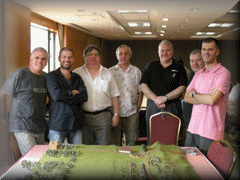
HKSW Meeting - Beijing Wargame Club
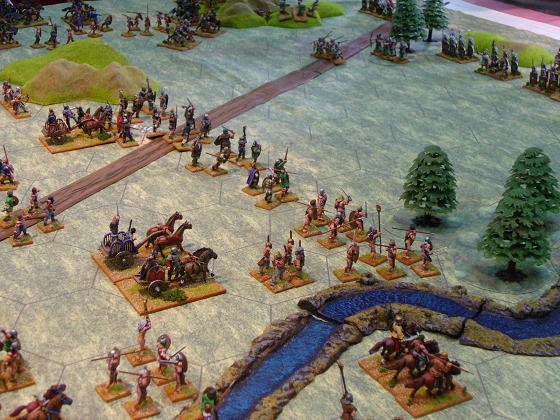
I played a couple of rounds of C&C Ancients with Angus from the Beijing Wargame Club who has been here for the last couple of weeks. We played the Cannae scenario swapping sides so we both got a chance to try each side.
As I found in my recent post on TMP about the Beijing Wargame Club stereotypes are very hard to break down. Many still see China as a heavily controlled police state with little freedom, but as Angus confirmed there are no 'taboos' in wargaming in Bejing. If you really want to wargame the invasion of Tibet you can do so without any worries, it was telling that he actually found the whole idea that there might be a problem somewhat amusing.
He's a great guy and if you ever pass though Beijing I recommend getting in touch with him and seeing if you can join in one of their club meetings. See below for more info.
Oh and for the record I won both games.
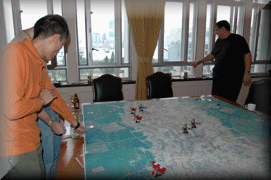
There was also a very interesting 15mm Waterloo game using Peter's A Near Run Thing rules.
Beijing Wargame Party Club (北京战棋党 in Chinese) was founded in 2006. There are currently around 20 core members, 7 of which form the executive committee. It has weekly gathering on Saturdays (unless there is special arrangement of "long holiday" as announced by the State government, then usually the gathering will be arranged on the second day of the holiday.) and usually there are 12 to 15 members attending each gathering. You are welcome to visit its (new and revamped) website (forum) at chinawargames.com (mainly in Chinese).
Angus can be contacted at angus_darius@yahoo.com.hk
Friday, June 18, 2010
Uniforms: Coraceros Espanoles

Comprising 6 companies of 70 men in 2 squadrons, being one squadron taken from the Cazadores de Olivenza and one squadron from the Hussars de Grenade (The Cazadores de Olivenza had also been used to form the Husares de Grenade in June 1808).
They were equipped with weapons, cuirasses and helmets captured by the Numancia Dragoon Regiment from the French 3e Provisional Cuirassiers at the battle of Mollet del Valles.
About 200 cuirassiers were killed or captured at Mollet, the prisoners were taken to the fortress of Lerida and the equipment was used to create the Coraceros Espanoles Regiment.
In 1815, as part of a larger reorganisation of the Spanish army, the Coraceros Espanoles were renamed the 3e Coraceros Espanoles, the saddle-cloth and the portmanteau had the numeric "3" added. All contemporary prints which show the numeric "3" are of the post reorgansiation unit not the Peninsular War unit.
The 2e Provisional Regiment was captured at Baylen (all their equipment was eventually returned to France). On 24 December 1809 the 1e Provisional Regiment was reinforced with the remnants of the 2e Regiment and became the 13e Cuirassiers. The 13e Curassier regiment was attached to Suchet Corps in Aragon. When Suchet entered in Catalonia on the 19th of May 1810 and conquered Lerida (April 1810) the French prisoners were liberated and the surviving men of the 3e Provisional Curassiers were incorporated into the 13e Curassiers.
The 3e Regiment was, however, not formally disbanded until early 1811 in Barcelona.
Uniforms: Austrian Army
General Austrian Uniform Info:
Osprey MAA 176 Infantry
Osprey MAA 181 Cavalry
Osprey MAA 223 Specialists
Osprey MAA 299 Austrian Auxiliary Troops 1792-1816
Osprey Warrior 24 Austrian Grenadiers and Infantry 1788-1816
Osprey Elite 101 Austrian Commanders of the Napoleonic Wars 1792-1815
Napoleon-Series:The Austrian Army in 1798: the Uniform Plates of Tranquillo Mollo and Joseph George Mansfield
http://www.napoleon-series.org/military/organization/Austria/c_Mollo.html
Napoleon-Series:Austrian Landwehr in 1809: the Uniform Plates of Joseph Eder
http://www.napoleon-series.org/military/organization/Austria/Landwehr/c_Eder.html
Napoleon-Series:Austrian Regular Infantry
http://www.napoleon-series.org/military/organization/c_ausinf1.html
Napoleon-Series:Austrian Cavalry Regiments and Their Commanders: 1792-1815
http://www.napoleon-series.org/military/organization/Austria/cavalry/c_austriancav.html
Napoleon-Series:Austrian Freikorps and Landwehr of the Wars of Liberation: the Uniform Plates of Friedrich Neumann
http://www.napoleon-series.org/military/organization/Austria/Landwehr/c_NeumannAustria.html
histofig
http://empire.histofig.com/-Historique,212-.html
Austrian Uniform Guide – Line Infantry
http://www.wtj.com/games/republique/uniforms/infoto_at_line-inf.htm
Small guide plus nice painted figures
http://diniums-loft.blogspot.com/search/label/Hapsburg
PDF of the Foundry catalog
http://www.freewebs.com/archiduccharles/AUSTRIANS%20pdf%20catalogue.pdf
napoleonistyka general info on the Austrian army
Austrian Army
http://napoleonistyka.atspace.com/Austrian_army.htm
Infantry
http://napoleonistyka.atspace.com/Austrian_infantry.htm
Cavalry
http://napoleonistyka.atspace.com/Austrian_cavalry.htm
Artillery (plus Engineers)
http://napoleonistyka.atspace.com/Austrian_artillery.htm
Uniforms: Duchy of Warsaw
(http://www.grosser-generalstab.de/adjutant.html)
Uniforms: Chasseurs de Montagne

They were comprised of local inhabitants, National Guard and draft dodgers. The draft dodgers had been promised amnesty by serving in the "Chasseuers de Montagne" with the assurance that they would only serve within France. In some departments such as the Ariege and the Basses-Pyrenees, the influx of draft dodgers was so great that they doubled the number of battalions. History would show that this promise was not kept.
The 1st Battalion Chasseurs de Montagne is formed from:
- 1st Battalion of the Pyrenees Orientales (1 Company)
- 1st & 2nd Battalion of the Haute-Garonne (2nd & 3rd Company)
- 1st Battalion of the Hautes-Pyrenees (4th, 5th & 6th Company)
The 2nd Battalion was formed with two battalions of the Ariege.
The 3rd Battalion was formed at the meeting by 8 companies of the battalions of Basses-Pyrenees and the reserve battalion.
- The five companies stationed in Jaca (1st & 2nd Coy)
- The reserve battalion in Bilbao (3, 4 & 5 Coy)
- The battalion of the Basses-Pyrenees employed in the 10th Division (6, 7 & 8 Coy)
- The 1st Battalion in the 116th regiment of the line,
- 2nd in the 4th light,
- The third in the 25th light.
Uniform
Article 7 of decret de portait: "The weapons, equipment and clothing are the same as they were in the last war with SpainThe problem is that the uniform of the 1793 French irregulars is not known, and therefore, in the absence of further research in the departmental archives, we rely upon simply classic uniformology that gives us:
The dress was that of the light infantry, with the background color of the cloth brown, with sky blue facings. It seems clear that the cutting of the uniform was not that of 1794, and the shako had replaced the hat.It is from this meager data that dress of the Chassuers de Montagne has been reconstructed.Further research in the archives of the departments concerned should provide answers to remaining questions.

It is difficult to use the word consistent when speaking of uniform of the Chasseurs de Montagne. The brown cloth remains the basis of the uniform. The facings sky blue. The headgear consists of a black shako without adornments and with a plate with a white eagle or diamond. The jacket of known variants: lapels, cuffs and collar for some blue sky, brown collar with blue piping (see red) for other . It seems that many Chasseuers have worn civilian clothes as shown in this application Wouillemont General dated 24 March 1809 and calls for " at least shakoes coats and absolutely indispensable to cover the ragged villagers three quarters of my men" .

See:
Napoléon Et Les Pyrénées -
Les Chasseurs Des Montagnes Et La Couverture De La Frontière 1808-1814
By Jean Sarramon
Link
Uniforms: Croatian troops under Napoleon
History and Organisation:
Uniforms: Kingdom of Württemberg
(http://www.grosser-generalstab.de/adjutant.html)
Uniforms: Useful Sites
Great for the history as well as unifrom information
Lots of uniform plates.
Huge collection of contemporary plates
by Alexander Mikaberidze
Cuirassiers, Dragoons, Horse-Jägers, Hussars, Lancers, Gendarmes, and the Train 1801-1825
Starting Over
Sunday, May 23, 2010
Carentan '44 in 6mm - WIP


Ehmke Art Württemberg Chevaulegers

Monday, April 09, 2007
6mm Terrain
I have recently been creating terrain specifically for 6mm hex based gaming using 1.4mm PPFoam basing.
Sunday, April 08, 2007
WWI dogfighting Knights of the Sky
Thursday, February 01, 2007
Robbed... Again...
http://www.hksw.org/07012%20cc.htm